Access to the full text of the entire article is only available to members of institutions that have purchased access. If you belong to such an institution, please log in or find out more about how to order.
‘Interculturalism’ describes cultural interaction which combines the methods of one culture with those of others. In practice, this often means the influence of non-Western traditions on Western art.
Drawing on a half century of documenting performance across multiple genres, from post-modern dance to physical theater to body work, as well as site-specific performance, with audiovisual examples from some 53 practitioners, including Eugenio Barba, Tim Etchells, Joan Skinner, Kristin Linklater, and Steve Paxton, Peter Hulton’s “A Digital Essay on Performance”considers performance as a body in operation with imagery and attempts to identify some of its foundational features.
Reflections on former Artistic Director of the Black Theatre Workshop, Quincy Armorer, who, in Africa Everywhere – Montreal, remarks on the company’s staying power as a primarily Anglophone and Black theatre company in a largely Francophone and white arts scene in Montreal.
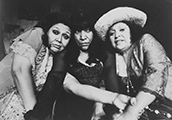
Lisa Mayo of the Kuna and Rappahannock Nations was a founding member of the Native
American women’s feminist theatre group, Spiderwoman Theater. She was a singer,
actor, and playwright who wrote and performed with Spiderwoman Theater for 35
years.
Brewster on her childhood in Jamaica, training at Rose Bruford and her subsequent career, as well as the difficulties of getting work as a black actress and the experiences of her contemporaries.
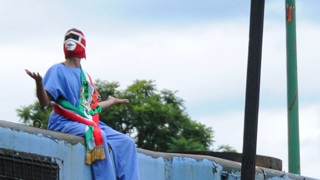
A film following the street performance Anabasis in Peru. It was an itinerant performance, based on exploiting the connections between the actors and the spectators who they encounter on their way.
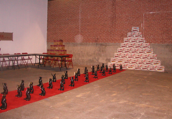
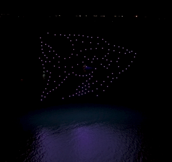
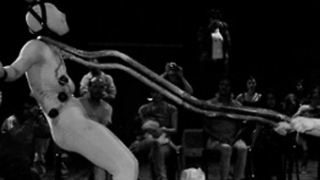
Battle of the Pyramids was a robotic performance installation featuring reconfigured Elmo toys performing military manoeuvres in rigid choreographed formations. This seminal artwork explored and used sensor and wireless communication to create clusters of entities moving in exact synchronisation in response to a call to arms. The robot's movements emulated the rigid and postured fighting strategies of Napoleonic warfare. These strategies, employed in Napoleon's Egyptian campaign, were particularly idiosyncratic in Egypt where they were persistently performed without consideration of either the desert environment or the fighting strategies of the enemy. The work is a testimony to the tragic consequences of imperialism and the dangers, follies and sadness of a rationale for blind obedience that makes victims out of warriors. The piece was exhibited at Light Industries in Theater of Code curated by Christiane Paul in 2008. It was funded by the Eyebeam Art and Technology Center and Professional Staff Congress CUNY Research Grant.
Strindberg Laboratory’s “demonstration project” through California
Arts Council’s “Prison Project” involving people who are about to be released
back into society.
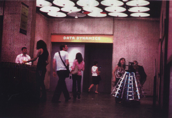
Camouflage Town is a pioneering telerobotic artwork. Camouflage Town is a decoy town constructed for the practice of military manoeuvres, war, and other scenarios of high drama. The robot, named "Kiru" , lived in the first-floor lobby and gallery of the Whitney Museum. As a telerobot, Kiru allowed remote visitors to communicate with physical visitors in the space. Remote visitors controlled the robot’s locomotion, pan, tilt and zoom of its camera over the web and spoke to museum visitors via text to speech and heard their responses. When autonomous, the robot relayed its history as the Librarian of Juxtapositions in Camouflage Town. This piece was exhibited at the Whitney Museum of American Art in DATA DYNAMICS curated by Christiane Paul in 2001. It was funded by the National Science Foundation Award, Cooper Union for the Advancement of Science and Art Robotics and Theater, Robotic Renaissance Project and NSF Gateway Engineering Education Coalition at Cooper Union.
Conquest and Prison is a two-part suite of site-specific dance films set
in Grahamstown, South Africa. The two oldest historical sites in Grahamstown are Ft.
Selwyn and the Old Gaol, which imprisoned thousands of black South Africans. The
choreography of Part I "Oscar's Journey" is Oscar Buthelezi's personal response to the
history of colonialism commemorated at Ft. Selwyn. Part II "Child's Play" is similar to
the approach in "Oscar's Journey." "Chorographers Lorin Sookool and Julia Wilson reflect
on the past as the sounds and images of the gaol continue to echo and resonate today.
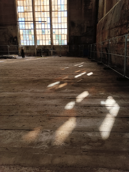
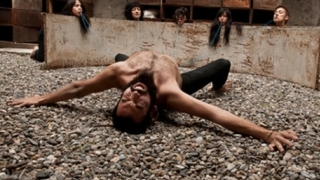
Decomposing Decay documents a collaborative artistic research project exploring the sonic and spatial relationships between bodies and a decomposing building with unique acoustics, investigating transformation and non-hierarchical creation methods as part of Behrens and Elle's ongoing "You and Me" series.
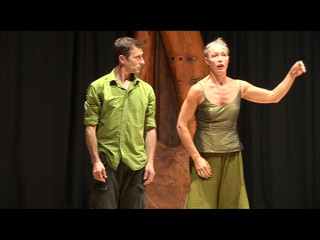
Zarrilli’s Psychophysical Acting methodology focuses on the relationship between the actor-as-doer and what the actor does. It (re)examines in practice and theory a psychophysical approach to acting.
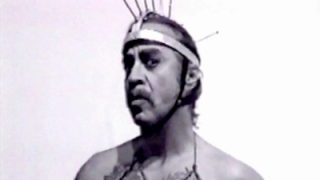
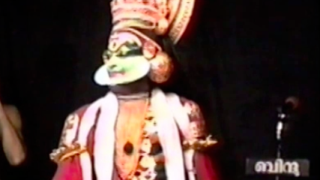
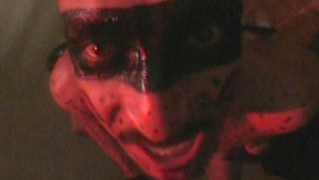
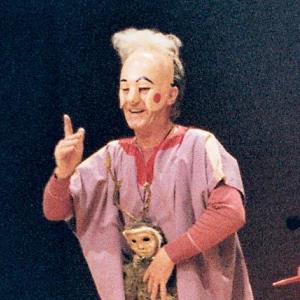
Videotaped in Kerala, India in 1993 and 1995, this film explains Kathakali's basic make-up types, the context of performance, the process and techniques of training, and performance preliminaries.
Kaash (Hindi word for ‘if’) was created in 2002 by Akram Khan when he was choreographer in residence of the Royal Festival Hall. He teamed up with celebrated talents Anish Kapoor and Nitin Sawhney.
Zarrilli’s Psychophysical Acting methodology focuses on the relationship between the actor-as-doer and what the actor does. It (re)examines in practice and theory a psychophysical approach to acting.
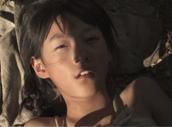
The film is a documentary about the life of a female shaman Kim Keum-hwa, who was shunned for being possessed by spirits as a girl and oppressed for following superstitions as an adult. It depicts how she grows to be a great shaman who embraces the pain of all people, and how she comes to be honoured as a national treasure of Korea because of her outstanding artistic talents throughout Korea’s tumultuous history. The film is based on the autobiography “Bidankkob Neom-Se” by Kim Keum-hwa.
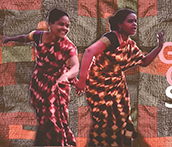
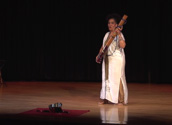
Siddi theatre performers and sisters, Geeta and Girija Siddi, performing in a
two-week festival, Telling Our Stories of Home: Exploring and Celebrating
Changing African & African Diaspora Communities.
A film made by Rekha Tandon’s company, Dance Routes, that begins with a description of Odissi’s background as a temple dance tradition, and an account of its basic form and ornamentation.
Sun, Moon and Feather presents a musical comedy-documentary about three Native American sisters growing up Native in an Italian neighbourhood in Brooklyn during the 1930s and 1940s.
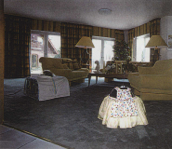
Tableaux Vivant Dans Un Monde Parfait was an interactive robotic installation. The work featured stereotypical “his” and “her” robots, directed by onsite users, which roamed a model home on the site of a factory manufacturing prefabricated homes in Brandenburg, Germany. The work was exhibited at Areale99 in Art in the Industrial Sector in 1999.
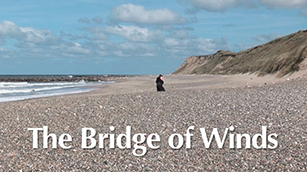
This film documents the work of Iben Nagel Rasmussen (Odin Teatret) with her
international group The Bridge of Winds during a two-week closed work session held
in December 2011.
Malika Ndlovu excavates universal themes of
self-discovery, the claiming of voice for the silenced, personal and social
transformation and the continuous awakening of the human spirit.
‘Each recorded text reveals a paradigm shift and an emotional faultline in my biographical journey to the North and my scary journey to the heart of the US Art World. This is one such audio text.’
‘Each recorded text reveals a paradigm shift and an emotional faultline in my biographical journey to the North and my scary journey to the heart of the US Art World. This is one such audio text.’
‘Each recorded text reveals a paradigm shift and an emotional faultline in my biographical journey to the North and my scary journey to the heart of the US Art World. This is one such audio text.’
‘Each recorded text reveals a paradigm shift and an emotional faultline in my biographical journey to the North and my scary journey to the heart of the US Art World. This is one such audio text.’
‘Each recorded text reveals a paradigm shift and an emotional faultline in my biographical journey to the North and my scary journey to the heart of the US Art World. This is one such audio text.’
‘Each recorded text reveals a paradigm shift and an emotional faultline in my biographical journey to the North and my scary journey to the heart of the US Art World. This is one such audio text.’
‘Each recorded text reveals a paradigm shift and an emotional faultline in my biographical journey to the North and my scary journey to the heart of the US Art World. This is one such audio text.’
‘Each recorded text reveals a paradigm shift and an emotional faultline in my biographical journey to the North and my scary journey to the heart of the US Art World. This is one such audio text.’
‘Each recorded text reveals a paradigm shift and an emotional faultline in my biographical journey to the North and my scary journey to the heart of the US Art World. This is one such audio text.’
‘Each recorded text reveals a paradigm shift and an emotional faultline in my biographical journey to the North and my scary journey to the heart of the US Art World. This is one such audio text.’
‘Each recorded text reveals a paradigm shift and an emotional faultline in my biographical journey to the North and my scary journey to the heart of the US Art World. This is one such audio text.’
‘Each recorded text reveals a paradigm shift and an emotional faultline in my biographical journey to the North and my scary journey to the heart of the US Art World. This is one such audio text.’
‘Each recorded text reveals a paradigm shift and an emotional faultline in my biographical journey to the North and my scary journey to the heart of the US Art World. This is one such audio text.’
Drawing on a half century of documenting performance across multiple genres, from post-modern dance to physical theater to body work, as well as site-specific performance, with audiovisual examples from some 53 practitioners, including Eugenio Barba, Tim Etchells, Joan Skinner, Kristin Linklater, and Steve Paxton, Peter Hulton’s “A Digital Essay on Performance”considers performance as a body in operation with imagery and attempts to identify some of its foundational features.
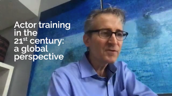
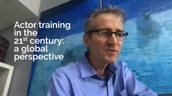
A six-part series featuring conversations with some of the foremost trainers across
four continents on subjects ranging from the cultural and political to
the professional and pedagogical.
Eugenio Barba created Odin Teatret in Norway in 1964, having worked with Jerzy Grotowski for three years in Poland. Now based in Denmark, its members come from a dozen countries and three continents.
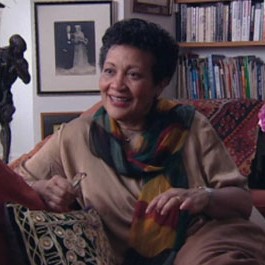
Yvonne Brewster was born in Jamaica in 1938. She set up Jamaica’s first professional theatre company at the Barn Theatre Kingston, and also co-founded the Talawa Theatre Company in the UK, in 1985.
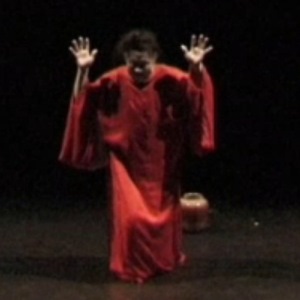
Tadashi Endo is a butoh dancer and teacher. He met Kazuo Ohno in 1989 and has since been deeply influenced by his work. He is founder and director of Germany’s Butoh-Center and Butoh-Festivals MAMU.
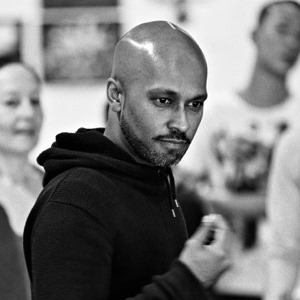
Akram Khan is one of the UK’s most acclaimed choreographers. Artistic Director of Akram Khan Company, he creates uncompromising artistic narratives which challenge conventional ideas of form.
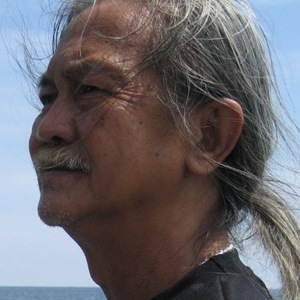
Inventor of an influential somatic and performance practice known as ‘Joged Amerta’, Suprapto Suryodarmo has taught and performed in Indonesia, Europe, Australia, the USA and India for over 25 years.
Activism is the intervention of an individual or group, using varied tactics, to disrupt and challenge inequality, and create transformation in the social, political, cultural or economic realm.