Access to the full text of the entire article is only available to members of institutions that have purchased access. If you belong to such an institution, please log in or find out more about how to order.
Site-specific performance is produced in non-theatre sites, and aims to engage with the meaning and history or creative impetus of those sites, and reach audiences who might not come to the theatre.
Drawing on a half century of documenting performance across multiple genres, from post-modern dance to physical theater to body work, as well as site-specific performance, with audiovisual examples from some 53 practitioners, including Eugenio Barba, Tim Etchells, Joan Skinner, Kristin Linklater, and Steve Paxton, Peter Hulton’s “A Digital Essay on Performance”considers performance as a body in operation with imagery and attempts to identify some of its foundational features.
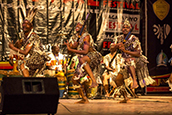
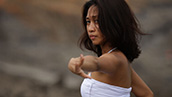
Atena/Nets is a collaboration among up-and-coming Ghanaian choreographers
featuring the quotidian theater found in the streets, markets and popular
culture of contemporary Ghana.
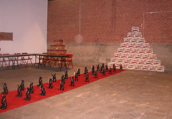
Battle of the Pyramids was a robotic performance installation featuring reconfigured Elmo toys performing military manoeuvres in rigid choreographed formations. This seminal artwork explored and used sensor and wireless communication to create clusters of entities moving in exact synchronisation in response to a call to arms. The robot's movements emulated the rigid and postured fighting strategies of Napoleonic warfare. These strategies, employed in Napoleon's Egyptian campaign, were particularly idiosyncratic in Egypt where they were persistently performed without consideration of either the desert environment or the fighting strategies of the enemy. The work is a testimony to the tragic consequences of imperialism and the dangers, follies and sadness of a rationale for blind obedience that makes victims out of warriors. The piece was exhibited at Light Industries in Theater of Code curated by Christiane Paul in 2008. It was funded by the Eyebeam Art and Technology Center and Professional Staff Congress CUNY Research Grant.
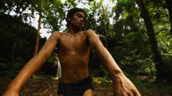
Filmed in Kalimantan (Indonesian Borneo), Body Without a Brain is a
high-risk, physically demanding dance for camera. Rianto seems to be in a trance as
he creates an unpremeditated encounter with the elements. He describes the work as
like a tree without roots. The piece embodies anxiety as the natural world becomes
ever more threatened.
Pearson takes a group of practitioners through the many exercises that formed the central concerns of Brith Gof. These include physical training, spatial and temporal awareness and group choreography.
Katharina Seyferth introduces the forest-based work space of Brzezinka, as she recounts her experience of Grotowski's post-theatrical research known as "Paratheatre" and "Theatre of Sources."
Camouflage Town is a pioneering telerobotic artwork. Camouflage Town is a decoy town constructed for the practice of military manoeuvres, war, and other scenarios of high drama. The robot, named "Kiru" , lived in the first-floor lobby and gallery of the Whitney Museum. As a telerobot, Kiru allowed remote visitors to communicate with physical visitors in the space. Remote visitors controlled the robot’s locomotion, pan, tilt and zoom of its camera over the web and spoke to museum visitors via text to speech and heard their responses. When autonomous, the robot relayed its history as the Librarian of Juxtapositions in Camouflage Town. This piece was exhibited at the Whitney Museum of American Art in DATA DYNAMICS curated by Christiane Paul in 2001. It was funded by the National Science Foundation Award, Cooper Union for the Advancement of Science and Art Robotics and Theater, Robotic Renaissance Project and NSF Gateway Engineering Education Coalition at Cooper Union.
Conquest and Prison is a two-part suite of site-specific dance films set
in Grahamstown, South Africa. The two oldest historical sites in Grahamstown are Ft.
Selwyn and the Old Gaol, which imprisoned thousands of black South Africans. The
choreography of Part I "Oscar's Journey" is Oscar Buthelezi's personal response to the
history of colonialism commemorated at Ft. Selwyn. Part II "Child's Play" is similar to
the approach in "Oscar's Journey." "Chorographers Lorin Sookool and Julia Wilson reflect
on the past as the sounds and images of the gaol continue to echo and resonate today.
This piece is an excerpt from a half-hour documentary shot in Grahamstown,
South Africa, during the annual National Arts Festival (https://www.nationalartsfestival.co.za/2016-festival/).
Interviews were conducted with a wide range of choreographers. This
selection focuses on up-and-coming artists Julia Wilson, Lorin Sookool,
Athena Mazarakis, and Kamogelo Molobye. The works are inspired
by challenges facing women, gays, and lesbians in contemporary South
Africa.
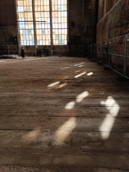
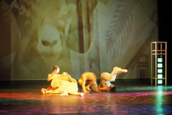
Decomposing Decay documents a collaborative artistic research project exploring the sonic and spatial relationships between bodies and a decomposing building with unique acoustics, investigating transformation and non-hierarchical creation methods as part of Behrens and Elle's ongoing "You and Me" series.
Lars Romann Engel, artistic director of “HamletScenen,” in conversation with
Dr. Anne Sophie Refskou, lecturer at University of Surrey, describes his process
of working on Shakespeare’s Hamlet. He analyzes the process of working with the
text and understanding the context of the play and its significance today. The
interview took place in Elsinore, Denmark, in August 2017.
This film, shot in the early part of the 1990s by leading Polish film-maker Jacek Petrycki, shows Gardzienice on the road in the Carpathian mountains in the Ukraine, rehearsing and training.
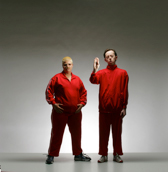
Back to Back Theatre creates new forms of contemporary performance imagined
from the minds and experiences of a unique ensemble of actors with disabilities,
giving voice to social and political issues that speak to all people.
Based in the regional centre of Geelong, the company is one of Australia’s
most globally recognised and respected contemporary theatre companies. Seeking
to make a body of work that exists in repertoire across time, the company tours
extensively locally, nationally, and internationally.
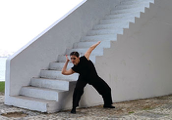
Site-specific dance is an investigation of space and place. A static sculpture — steps without a destination — is transformed by dance asking: What is this place? Why are we here? Where are we going? The city across the river is lost in mist. The GIFTED dancers inscribe the landscape. Their gift transforming geometry and perspective, re-structuring space. Filmed on location Almada, Portugal.
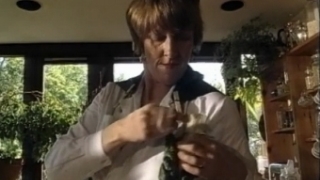
A performance piece which saw Baker open her kitchen to the public and display a set of live actions, making performance from everyday tasks which nevertheless require skill, dexterity and endurance.
The Soul of Dance is an introduction to the vibrant diversity of contemporary dance
in Indonesia. Rooted both in tradition and the idioms of modern movement this half
hour documentary introduces audiences to work ranging from site-specific solos to
multimedia musical theater.
A public domain
theatre show,
part voyeuristic meditation, part urban
thriller, it unfolds amidst the high volume
pedestrian traffic of a public
space.
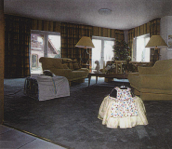
Tableaux Vivant Dans Un Monde Parfait was an interactive robotic installation. The work featured stereotypical “his” and “her” robots, directed by onsite users, which roamed a model home on the site of a factory manufacturing prefabricated homes in Brandenburg, Germany. The work was exhibited at Areale99 in Art in the Industrial Sector in 1999.
Jean Isaacs presents an annual festival of site-specific dance in San Diego, CA. Original dances are created alongside San Diego’s iconic red trolleys. The special energy of this event comes from interaction of artists immersed in the community. In this project art and "real-life" are not rigidly distinct realms. The documentary takes a behind the scenes look at the months long process of creation.
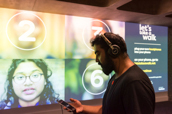
A look at the science behind human perception through performance lectures,
surround sound, hidden televisions, and sweeping panoramic views of the London
skyline.
A look at the science behind human perception through performance lectures,
surround sound, hidden televisions, and sweeping panoramic views of the London
skyline.
Drawing on a half century of documenting performance across multiple genres, from post-modern dance to physical theater to body work, as well as site-specific performance, with audiovisual examples from some 53 practitioners, including Eugenio Barba, Tim Etchells, Joan Skinner, Kristin Linklater, and Steve Paxton, Peter Hulton’s “A Digital Essay on Performance”considers performance as a body in operation with imagery and attempts to identify some of its foundational features.
The films Waterline and Ways to Disappear show the progress of the creative process creating changes in the lives of the incarcerated, their communities, and society.
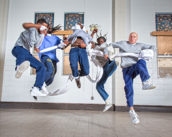
Atena/Nets (2019) is a 6-½ minute site-specific contemporary dance set in
Jamestown, a traditional fishing community in Accra, the capital of
Ghana which shows roots in both traditional customs and in an
appreciation for international dance practice.
Urban Sensographis examines the effects the evolution of the cities in the 21st century has on the practices and behaviours of urban dwellers. Key factors such as defensible, retail and consumer space, the lasting legacies of modernist design in the built environment, surveillance technologies, motorised traffic, and smart phone use, the integration of ‘wild’ as well as ‘domesticated’ nature in urban planning and living, as well as the impact of urban pollution on the earth’s climate.
The films Well Contested Sites Separate Sentences reflect on the plight of the incarcerated and exposure of their plight, both the condition and the societal issues, to society at large.
Mike Pearson, Professor of Performance Studies at Aberystwyth University, has been creating physical and site-specific works since 1971. He was Artistic Director of pioneering Brith Gof from 1981–97.
Mike Pearson, Professor of Performance Studies at Aberystwyth University, has been creating physical and site-specific works since 1971. He was Artistic Director of pioneering Brith Gof from 1981–97.
Environmental theatre, like site-specific work, aims to alter the conventional spatial practices of performance and to enhance the performance’s engagement with its space and site of production.




![you'll see me [sailing in antarctica] — non zero one — Trailer](/propagator/data/img-dc/original/image/youll-see-me-sailing-in-antarctica-non-zero-one-trailer/image-thumb-191102.jpg)
![you’ll see me [sailing in antarctica] – non zero one – Full length Wide](/propagator/data/img-dc/original/image/youll-see-me-sailing-in-antarctica-non-zero-one-full-length-wide/image-thumb-191101.jpg)