Access to the full text of the entire article is only available to members of institutions that have purchased access. If you belong to such an institution, please log in or find out more about how to order.
The term ‘installation art’ has been used since the 1960s to designate art practice which explicitly aims to include and refer to its site and context as a crucial constituent of its meanings.
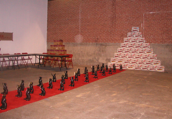
Battle of the Pyramids was a robotic performance installation featuring reconfigured Elmo toys performing military manoeuvres in rigid choreographed formations. This seminal artwork explored and used sensor and wireless communication to create clusters of entities moving in exact synchronisation in response to a call to arms. The robot's movements emulated the rigid and postured fighting strategies of Napoleonic warfare. These strategies, employed in Napoleon's Egyptian campaign, were particularly idiosyncratic in Egypt where they were persistently performed without consideration of either the desert environment or the fighting strategies of the enemy. The work is a testimony to the tragic consequences of imperialism and the dangers, follies and sadness of a rationale for blind obedience that makes victims out of warriors. The piece was exhibited at Light Industries in Theater of Code curated by Christiane Paul in 2008. It was funded by the Eyebeam Art and Technology Center and Professional Staff Congress CUNY Research Grant.
Camouflage Town is a pioneering telerobotic artwork. Camouflage Town is a decoy town constructed for the practice of military manoeuvres, war, and other scenarios of high drama. The robot, named "Kiru" , lived in the first-floor lobby and gallery of the Whitney Museum. As a telerobot, Kiru allowed remote visitors to communicate with physical visitors in the space. Remote visitors controlled the robot’s locomotion, pan, tilt and zoom of its camera over the web and spoke to museum visitors via text to speech and heard their responses. When autonomous, the robot relayed its history as the Librarian of Juxtapositions in Camouflage Town. This piece was exhibited at the Whitney Museum of American Art in DATA DYNAMICS curated by Christiane Paul in 2001. It was funded by the National Science Foundation Award, Cooper Union for the Advancement of Science and Art Robotics and Theater, Robotic Renaissance Project and NSF Gateway Engineering Education Coalition at Cooper Union.
Decomposing Decay documents a collaborative artistic research project exploring the sonic and spatial relationships between bodies and a decomposing building with unique acoustics, investigating transformation and non-hierarchical creation methods as part of Behrens and Elle's ongoing "You and Me" series.
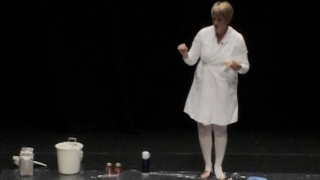
A work that built on Baker’s experience of using autobiographical materials in performances such as My Cooking Competes, blending this with a commentary on domesticity, motherhood and art.
Back to Back Theatre creates new forms of contemporary performance imagined
from the minds and experiences of a unique ensemble of actors with disabilities,
giving voice to social and political issues that speak to all people.
Based in the regional centre of Geelong, the company is one of Australia’s
most globally recognised and respected contemporary theatre companies. Seeking
to make a body of work that exists in repertoire across time, the company tours
extensively locally, nationally, and internationally.
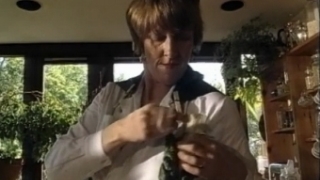
A performance piece which saw Baker open her kitchen to the public and display a set of live actions, making performance from everyday tasks which nevertheless require skill, dexterity and endurance.
A public domain
theatre show,
part voyeuristic meditation, part urban
thriller, it unfolds amidst the high volume
pedestrian traffic of a public
space.
Tableaux Vivant Dans Un Monde Parfait was an interactive robotic installation. The work featured stereotypical “his” and “her” robots, directed by onsite users, which roamed a model home on the site of a factory manufacturing prefabricated homes in Brandenburg, Germany. The work was exhibited at Areale99 in Art in the Industrial Sector in 1999.
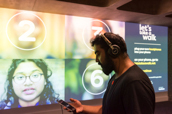
A look at the science behind human perception through performance lectures,
surround sound, hidden televisions, and sweeping panoramic views of the London
skyline.
A look at the science behind human perception through performance lectures,
surround sound, hidden televisions, and sweeping panoramic views of the London
skyline.
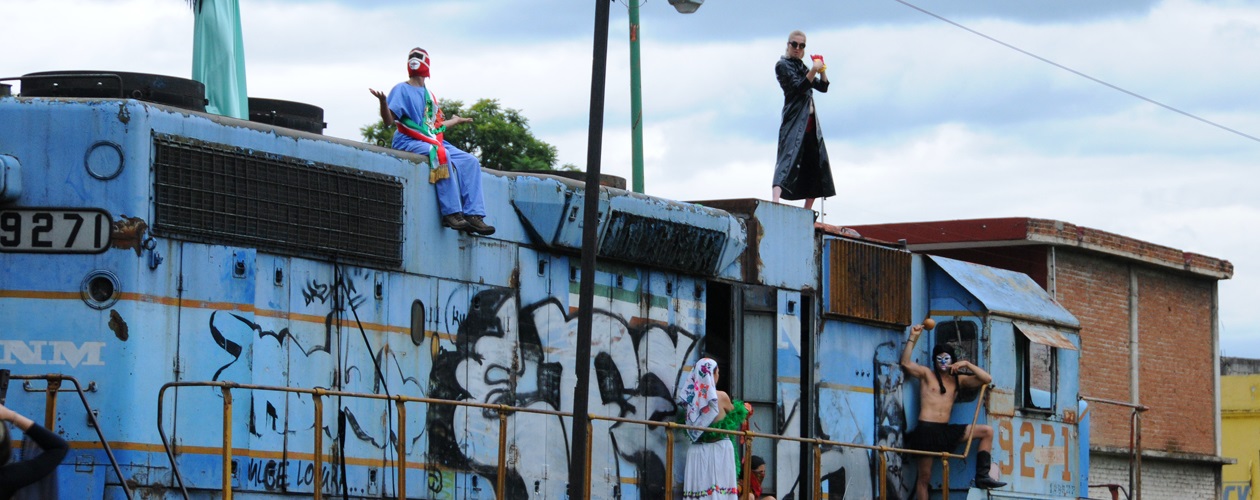
Guillermo Gómez-Peña is an artist, writer, activist, radical pedagogue and director of the performance troupe La Pocha Nostra. His work has contributed to debates on diversity and border culture.
Environmental theatre, like site-specific work, aims to alter the conventional spatial practices of performance and to enhance the performance’s engagement with its space and site of production.



![you'll see me [sailing in antarctica] — non zero one — Trailer](/propagator/data/img-dc/original/image/youll-see-me-sailing-in-antarctica-non-zero-one-trailer/image-thumb-191102.jpg)
![you’ll see me [sailing in antarctica] – non zero one – Full length Wide](/propagator/data/img-dc/original/image/youll-see-me-sailing-in-antarctica-non-zero-one-full-length-wide/image-thumb-191101.jpg)